
Perovskite carrier dynamics & photoluminescence characterisation
Film, nanowire or completed device: choose a measurement around the information you need, rather than the instrument name alone.
Which question comes first?
| Research question | Measurement approach | Product starting point |
|---|---|---|
| How does the photoexcited signal evolve? | Transient absorption spectra and kinetics | TA-PRO or TA-LITE |
| Where do emission and lifetime differ? | Spatially resolved intensity and lifetime imaging | FLIM500 |
| What changes across a photovoltaic device? | Combined optical and device measurements | Solarium-L |
These measurements are complementary, not interchangeable. A brighter region or longer lifetime should not be interpreted as better device performance without considering the sample and measurement conditions.
From sample to experiment
- Describe the specimen. Include composition, substrate, thickness, encapsulation and whether electrical contacts are available.
- Define the output. A spectrum, kinetic trace and spatial map answer different questions. Select the one needed to test your hypothesis.
- Set comparable conditions. Record excitation wavelength, fluence, collection geometry and environment. Keep these consistent when comparing processing conditions or samples.
- Plan interpretation. Discuss instrument response, background subtraction and fitting assumptions before assigning a physical mechanism.
What the measurements look like
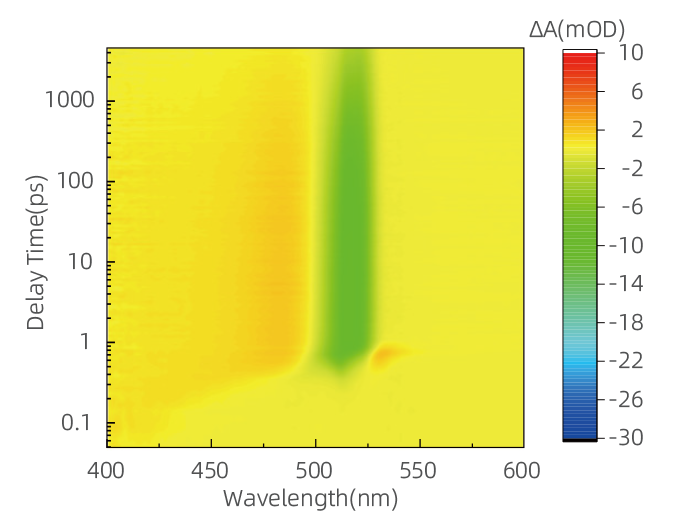
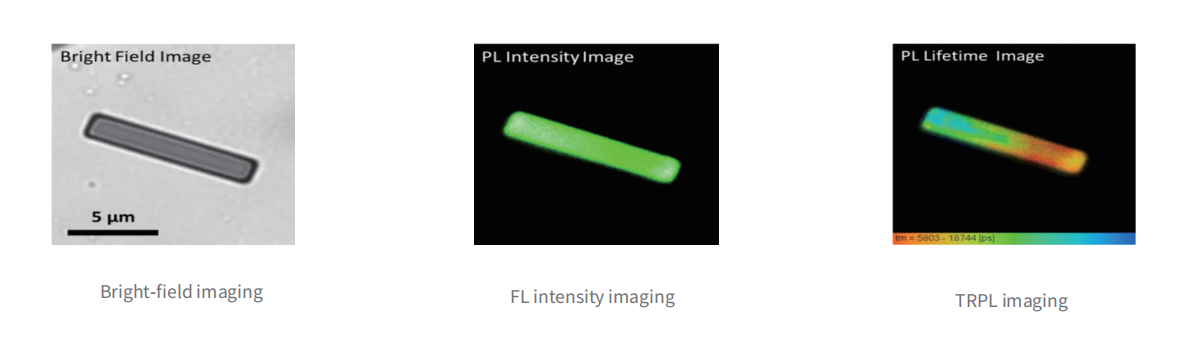
Sources: Time-Tech Spectra TA-PRO and FLIM500. These are separate samples and experiments, not a side-by-side instrument performance comparison.
Questions to resolve with HX
Should we start with TA or fluorescence measurements?
Begin with your hypothesis and the expected signal. Send existing absorption or emission data if available. HX can help define the questions for the manufacturer before recommending a configuration.
Can we reuse an existing laser?
Share wavelength, pulse width, repetition rate, pulse energy and synchronization information. Compatibility needs checking across the full setup; a matching wavelength alone is not sufficient.
What information helps with a device measurement?
Include the layer stack, active area, contact geometry, operating bias and the measurement environment. Identify whether spatial mapping or an area-averaged result is required.
Discuss your perovskite experiment
Tell us your sample structure, desired time scale, excitation range and whether you need a spectrum, image or device measurement.